




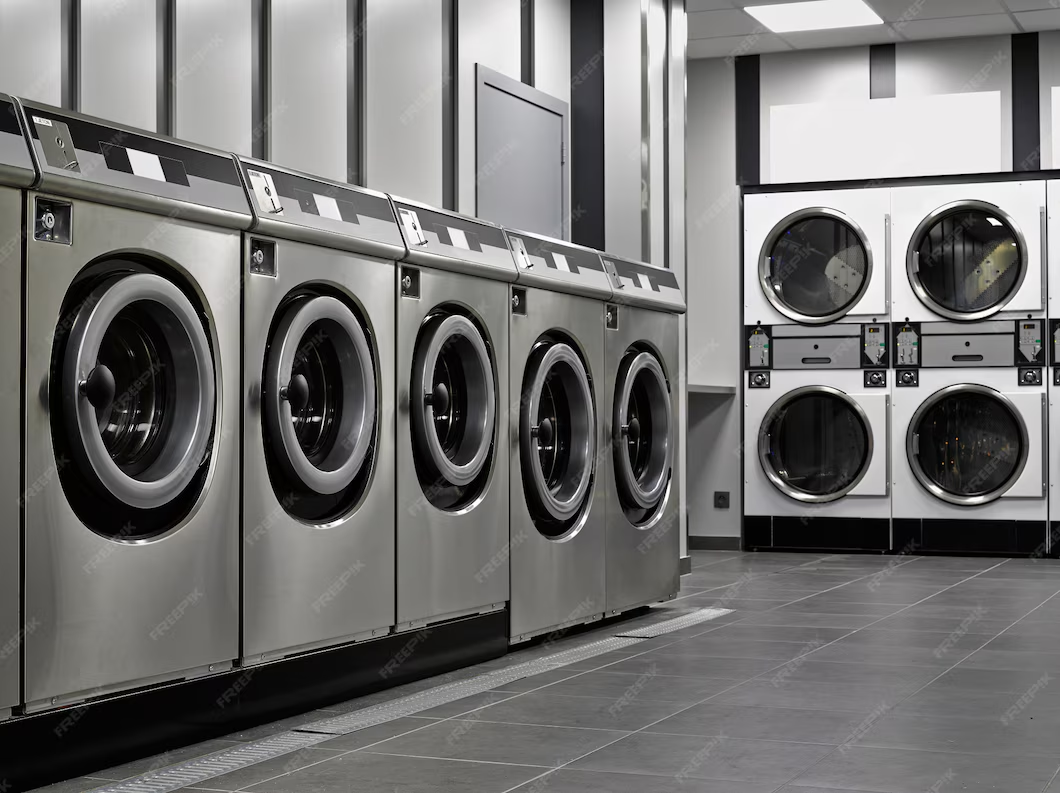
Energy efficiency of Dryers
The Speed Queen SST30 (part of the Stacked Washer-Extractor/Tumble Dryer series) represents a benchmark in commercial laundry engineering. While the “SST30” designation refers to the stacked system, the drying component is functionally equivalent to the STT30 30lb tumbler.
In the commercial sector, energy efficiency isn’t just about a “star rating”; it is measured by Thermal Efficiency, Specific Energy Consumption (SEC), and Throughput Speed.
1. Core Technical Specifications (Per Pocket)
To evaluate the SST30, we must first look at the raw physical parameters that dictate its thermodynamic potential.
| Parameter | Specification (Gas Model) | Specification (Electric Model) |
| Capacity | 30 lbs (13.6 kg) | 30 lbs (13.6 kg) |
| Cylinder Volume | 10.6 cu. ft. (301 liters) | 10.6 cu. ft. (301 liters) |
| Heat Input | 73,000 BTU/hr (21.4 kW) | 21 kW |
| Airflow | 400 CFM (60Hz) / 340 CFM (50Hz) | 400 CFM (60Hz) / 340 CFM (50Hz) |
| Motor (Fan) | 0.5 HP (0.37 kW) | 0.5 HP (0.37 kW) |
| Exhaust Diameter | 8 inches (200 mm) | 8 inches (200 mm) |
| G-Force (Washer) | 440 G (Extract) | 440 G (Extract) |
2. Efficiency Pillars: The “Speed Queen” Difference
The SST30 achieves a 40% lower energy input compared to traditional classic tumblers. This is driven by three primary technical innovations:
A. Axial Airflow Pattern
Unlike many commercial dryers that use Radial (side-to-side) or Cross-flow patterns, the SST30 utilizes Axial Airflow.
- Mechanism: Air enters from the back of the cylinder and exits through the front door.
- Efficiency Impact: This ensures that the heated air passes directly through the tumbling linens before reaching the exhaust. It maximizes the contact time between the dry air and the wet fabric, reducing “short-circuiting” where air bypasses the load.
B. Over-dry Prevention Technology (OPT)
In commercial laundries, labor often costs 10x more than utilities, but over-drying kills both.
- Technical Logic: OPT uses a rotary transfer switch to sense moisture levels thousands of times per second.
- Metric: Speed Queen labs report 31% less fiber loss and roughly 5% total utility savings annually by stopping the cycle the moment the target moisture level (usually 0–4%) is reached.
C. The “System” Efficiency (440 G-Force)
The SST30 is a stacked unit. Its efficiency is technically tied to its paired washer-extractor.
- Impact: By extracting water at 440 G-force, the washer removes significantly more moisture than a standard 100G or 200G machine.
- Energy Math: For every 1% of additional moisture removed in the wash, you save roughly 2–3 minutes of drying time, drastically lowering the BTU requirement per load.
3. Advanced Thermodynamic Analysis
When engineers audit commercial dryers, they use these three advanced parameters:
I. Specific Energy Consumption (SEC)
SEC measures the energy required to evaporate 1 kg of water.
- Typical Commercial Range: 5.5 to 7.0 MJ/kg.
- SST30 Performance: Due to the sealed cylinder rims and axial flow, the SST30 operates at the lower end of this range (approx. 5.6–5.8 MJ/kg), making it one of the most efficient vented tumblers in its class.
II. Thermal Efficiency Ratio (𝜂)
This is the ratio of energy used for evaporation versus total energy input.
𝜂=(Energy for Evaporation) / (Total BTU Input)
The SST30 minimizes “Sensible Heat Loss” (heating the machine’s metal) and “Exhaust Loss” (un-utilized hot air) through its concentrated heater box and sealed cylinder rims, maintaining an industry-leading thermal efficiency.
III. Airflow-to-Heat Ratio
The SST30 maintains a balanced ratio of CFM per 1,000 BTU.
- Over-heating: High BTU with low CFM scorches fabric.
- Inefficiency: High CFM with low BTU wastes fan power.
- SST30 Balance: At approx. 5.5 CFM per 1,000 BTU, the SST30 ensures air is saturated with moisture before it is exhausted, preventing the “dumping” of dry heat.
4. Operational Savings Summary
Pro Tip: In a 10-hour-per-day operation, the SST30’s efficiency features (Quantum Touch + OPT) can reduce daily run-time by up to 80 minutes compared to manual-timer competitors. This translates to roughly 15–20% lower gas/electricity bills and a 10% increase in laundry room throughput.


